Editorial
On the front cover of this issue is a photograph of Brother Michael Grix. This photograph was taken some years ago before the advent of cancer. This is the 'Michael Grix' most of his friends would have known. A humble diffident Salesian who befriended many through the countless letters of support and encouragement he wrote. Michael died in Christie's Hospital, Manchester, on May 7th after 18 months of pain, of treatment, and of loving care. At the end of this issue we have the customary obituary for Michael and for three other Salesians. Because Michael meant so much to me and to so many of our readers I would like to reflect in this editorial on what I learnt from his suffering. Many readers who have been close to those suffering from cancer may find echoes of their own feelings in what I write. It is with a certain trepidation that I pen these words, I write out of immense admiration for a friend whose suffering overwhelmed me. However I feel I need to record the love I came to know, the love his suffering drew from so many, carers who became true friends.Michael was a humble man who never gloried in his achievements, he was not aware for years of how many people appreciated him, and of how much he meant to them. Thousands of them. The ministry of letter writing can be a tremendous drain upon the soul. "Have I said the right thing? Have I understood the need?" Michael's diffidence and genuine humility never filled him with the certainty of great confidence. He hid behind his natural sense of humour and played down any notion of success. A smile, a joke, encouragement for everyone but not for himself. Then came cancer in all its ferocity, and things changed radically. With suffering came affirmation. In his community, in Saint Joseph's (our house for elderly Salesians), Michael found true friends. In the hundreds of letters he received he found his affirmation. As we saw the old Michael become progressively disfigured by cancer, we saw a new Michael; confident, patient, extraordinarily happy in his community. The friendship of those who cared for him and those who visited him was a powerful lesson for me of the transforming effect of love. They, in their turn, will say that they found his prayerful acceptance of whatever suffering came to him a powerful and humbling experience of genuine goodness. We dare not trivialise the evil of cancer, but we cannot exaggerate the heroism of Michael who suffered, nor the love of those who cared for him.
Tony Bailey SDB
Editor
mondonio@msn.com
Good Shepherding by David O'Malley SDB
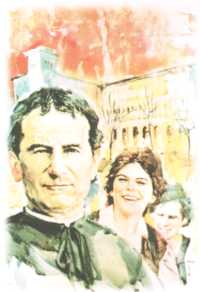 The environment within which we grow up is a vital element in the development of each person. Much of our behaviour, our development of talent and the way we see life emerges from the complex chemistry of our environment. By creating the right environment we can assist young people to get closer to their full potential.
 Don Bosco's crucial dream at the age of nine underlines the importance of a warm and friendly environment in nurturing young people towards the fullness of life. In the dream he encounters a group of wild, foul-mouthed and fist-throwing youths. Later in the dream they turn into a pack of wild animals. A mysterious feminine presence in the dream encourages the young Bosco to deal with the wildness by creating an atmosphere of gentle consistent kindness rather than lashing out with his own fists. She held out the hope that John could make a difference and behaviour could be changed if he could create an atmosphere of reasoned kindness. When he tried this in the dream the lads changed into normal balanced youths who could celebrate and enjoy life to the full. The rest of Don Bosco's life was an attempt to repeat that hope-filled miracle in young lives thrown into chaos by an industrial revolution fragmenting inner city Turin.
As his work for young people developed it is interesting to note that Don Bosco kept his hopes for a nurturing environment concrete and realistic. For example, in admitting young people to one of his projects he said that he wanted to guarantee that they would not get any worse than when they entered. While he was aware of the challenging behaviour of a young person, he was confident of the ability of his environment to manage that behaviour without others becoming worse as a result of the new admission. A practical example of such thinking occurred when Don Bosco admitted a large group of war-orphans from Ancona who were aggressive and traumatised. He allowed them all into his educational community because he judged that his well-balanced staff and young people could contain and help them through their trauma. Don Bosco saw the environment not simply as a physical space that was safe and resourced, but also as a network of relationships marked by consistent kindness. That network involved young people as well as adults, parents as well as educators, volunteers and ex-members who were now in a wider community in the city. All of those connections would have played their part in the process of welcoming those troubled youths and helping them deal with the trauma of war and loss.
The teams he created were highly focussed on the importance of gentleness, optimism and reasonableness from everyone. Above all he stressed the importance of a friendly rather than a policing presence. This friendly presence, supported by reasonable and consistent rules was the visible background to his approach to a life-giving environment. There was also an invisible spiritual dimension holding this environment together based on an awareness of the mystery of God, present in every moment and in each person. That broad spirituality added depth and motivation to the ordinary routine of both adults and young people, helping to create a community that nurtured life at many levels.
The environment of home, school and of groups is held together by three practical threads that weave through all of our lives. By attending to relationships, boundaries and individual needs we catch the dream in practical activity every day. Looking at those threads we are challenged to know ourselves, act consistently and put ourselves in the place of another before we make judgements about them. Don Bosco said that using his approach would be easy for the young people but difficult for the adults responsible. He realised that adults would need to be mature to maintain this environment. They in turn would need support from each other in order to be present, friendly and reasonable with young people. Relationships, boundaries and individual needs, these threads lie waiting to be picked up in every meeting.
This is all good common sense, but behind this visible good practice lies a deeper spirituality. Attending to the group, the individual and to boundaries was also the work of the good shepherd as described in Saint John's Gospel. That shepherd figure was able to notice the individual sheep, calling each by it's name. He was able to move his focus from the individual to the whole group and set up boundaries within which they could be safe. For those who try to create the special environment, this hidden spirituality becomes available to give deeper meaning and motivation to their work and relationships with young people. The environment adults build, either as parents, teachers or youth workers, can have a spiritual dimension in so far as they imitate the Good Shepherd. This optional and spiritual interpretation is a personal choice that can change a role, from a job into a vocation.
Don Bosco saw this shepherd-image as the dynamic presence that created the safe environment where the young could grow. He also realised it was a vocational choice. When parents, teachers and youth workers are aiming to be a good shepherds, they are challenged to make sacrifices. In laying down their lives for the young they grow in wisdom and maturity. Creating a life-giving environment is part of the Don Bosco tradition. It may not have all the answers for a severely damaged young person, but for the average youngster the common sense kindness of its approach can make minor miracles a regular occurrence.
The following questions might help us gauge our awareness of our contribution to this environment.
Look at the boxes in this article and see where you are the strongest and weakest link in creating a positive environment within your own setting.
Attending to Relationships
|
Are you aware of the quality of your language... * Is it optimistic as well as realistic? * Is it warm and genuine? Do your conversations leave the other person hopeful... * Even if you need to say something negative? Do you allow others time to speak... * And really hear what they are saying? Do you make shared decisions... * Do you involve others where you can? * Or do you always push your ideas through without finding consensus? Do you stop and celebrate when the group has achieved something... * Or do you just remind them of how much further they need to get? Are you organised enough to waste time... * Do you build in space for conversations that strengthens links, builds friendships and is person-centred? * Do you give time for this to both young people and adult colleagues? Are you aware of that mysterious thing called 'atmosphere'... * between individuals and groups Can you say you are sorry when things go wrong... * Do you give time to repair connections? * Or waste energy trying to avoid the person involved for weeks? |
Attending to Boundaries
|
Are you realistic in setting standards... * Or do you expect the impossible from young people and act surprised when they fail? Do you gain support for basic rules... * Through reasoned argument rather than setting arbitrary rules that suit the adults involved? Do you put boundaries around your own feelings as an adult... * Or does anger, favouritism or sadness creep in to blur the picture? Are you clear and consistent in dealing with breakdowns in behaviour... * While still respecting the dignity of people and their responsibility for their own actions? Are you committed to continual repetition of the basic rules and values... * In order to reinforce a safe environment? |
Attending to individual needs
|
Do you notice changing patterns in individual behaviour... * And reflect on their significance? Do you respond to affection or aggression in a balanced and secure way... * So that the young person can grow through those feelings safely? Do you notice absences as well as who are present... * Do you notice who is withdrawing or been pushed to the edge of the group? Do you remember names, favourite music, stories... * and other details about young people? Do you recognise needs that require special help... * And be ready to refer young people to others who can help * Or do you want to solve problems yourself? Do you correct and praise quietly when appropriate... * In order to get the message across more clearly, * Especially to young people who are quieter? |
A Child Again by Tony Bailey SDB
 Proof reading, as anyone who has had to do it will know, is like looking for a needle in a haystack. To read what you have read countless times looking for typing errors is no enjoyable pastime. So reluctantly I started proof-reading our new edition of the life of Don Bosco for primary school children. It had been produced in France and translated into many languages, including English. However the English version was from the USA and I had been advised by a primary school teacher that the American spellings would make it unacceptable in primary schools in the UK. Bowing to her superior knowledge and sensing an opportunity, I asked her to produce a 'UK English' version for me. Surprisingly she accepted though she demanded some crucial changes to the illustrations, "Not politically correct!", she kept muttering.
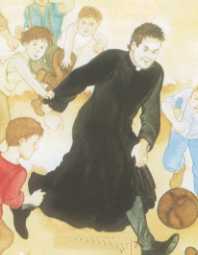
 So here I was, a primary school child again, engrossed in a book, lost to the world. I was prepared to be bored, after all I did know the Don Bosco story rather well. Page one, and I was back in the Piedmont hills of the 19th century, in the little village of Becchi, with the Bosco family struggling to make ends meet. I felt great sympathy for them. I followed the keen student Bosco through seminary. I glanced at the picture of the young priest, Don Bosco, in his black cassock. What would children today make of that, probably some of them had never seen a cassock. Well I suppose seeing a picture of Don Bosco playing football in a cassock might help. The dusty playground of the Turin oratory was a far cry from today's opulent stadium of Juventus, Turin's famous football team. Enjoying a game of football with children catches the spirit of Don Bosco. No wonder so many young men and women were inspired by him to become missionaries and spend their lives working in what we now call the third world. Young people are just as generous today, many of them are prepared to go as volunteers to help others in less fortunate circumstances. Don Bosco remains a great role-model for generous youngsters today.
But I supposed to be proof-reading and here I was totally absorbed in the story bound to miss some typing error. It was difficult to concentrate on proof-reading, I had become so engrossed in the story, surprisingly moved by it. Strange isn't it?
No matter how many times I read the life of Don Bosco it always holds a certain fascination for me. There I was, a child again, enjoying a good read. I know that children today will enjoy this story as much as I did.
|
The friend of children and young people Series: Along the paths of the Gospel Available from Don Bosco Publications Price: £3.99 (+ P&P 80p UK only) |
Sharing Cultures
VIDES UK KENYA 2000 PROJECT, 7-28TH AUGUST 2000(VIDES - derived from the Italian for 'International Volunteers for the Education and Development of Women.')
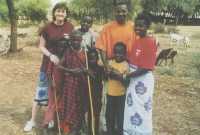 Siobhan Moore, Kate Keane, Sister Elizabeth Purcell, Sister Connie Cameron, Rachael McNamara, Will Griffiths, Lisa Jones, Chris Folkes, Penny Fox, all set off for Kenya last August.
The purpose of this expedition was:
* To share their lives and culture with a group of Kenyan people.
* To hold a summer school for the children of the town of Namanga Kenya, and spend recreational time with them.
* To work alongside a team of Kenyan volunteers
* To establish a Kenyan branch of Vides.
Throughout our three weeks in Kenya, the English and Kenyan volunteers lived as community. We worked together on every task, teaching, planning activities, cooking, preparing Mass and prayer, and other day to day activities. From day one we related well to the Kenyan volunteers with their obvious joy of life, deep faith, love of music and dance and abundant generosity. The Kenyan volunteers went out of their way to welcome us and help us to feel part of their lives. The ice broke quickly. By the time the first week was over, we were really 'together' as a group and getting to know a lot about each other. We shared each others food, dance, music and even clothing. But more important than that, we talked to each other about our lives - our family, friends, home, school, beliefs and values, the things that are important to us.
While the volunteers from the UK tended to be more systematic, the Kenyans were much more laid back and relaxed in the way they worked. We soon got used to each others ways. Each nationality accepted the other just as it was. The group was happy together, we felt extremely welcomed by the people of Namanga. We felt we had really lived as Kenyans. We left feeling enriched and extremely privileged to have been given the opportunity to be part of this experience.
The Children
Eager, enthusiastic, wonderful, excited', 'friendly', 'gorgeous'; just some of the words we used to describe the children in the project journal. They really were a pleasure to be with. Our mornings with the children were spent in school, teaching English, Maths, and Kiswahili, the Kenyan national language. We had between 400-500 children each day, aged approximately 10 to15, although some very keen younger children managed to sneak in! In Kenya, parents have to pay to send their children to school and so education is highly valued which is why so many turn up in their summer holidays. They really were very eager, often arriving at school long before lessons began. Teaching is very different in Kenya. The classrooms consisted of bare concrete walls, a corrugated iron roof, splintered benches and narrow desks, and very old blackboards. Lessons are often learnt 'parrot-fashion' with the children repeating together sentences and equations. Class sizes are huge; we had over 50 in some classes. The children don't ever seem to work in groups or pairs. They are disciplined by corporal punishment in their schools.Obviously we did not use corporal punishment. The children soon adapted to a different style of working. They welcomed positive reinforcement as a way of ensuring good behaviour in the classroom, due to the point system we established from the start. Points mean prizes! So they were well rewarded for their good behaviour, effort and co-operation. And most importantly they enjoyed it as did all the volunteers.
Many of us had no experience of teaching before, so it was a very daunting situation to be in. It was for the teachers as well? as. It was so different to teaching in the UK. But we got used to it quickly. We were all amazed by how keen and co-operative the children were. They were really helpful. They would often wait for us before and after school to help carry our bags and books.
Things got a bit more hectic in the afternoons! The children came for about two and a half hours. For the first half we played games with the whole group, about 600 children. Then we split into groups to do different activities, arts and craft, singing and dance, volleyball and football. Children of any age could come and we got a lot of infant and nursery children so we also had separate activities for them.
The afternoons were exhausting but really good fun. At first, we tried to be a bit too organised. We tried putting them all into groups for the big activity; but they all just went into whichever group their friends were in, often changing to a different group after a while. After a few days we just let them join whichever team they wanted. We became a bit more laid back, a more Kenyan way of doing things.
Looking back, it's amazing to think that we actually managed to do what we did with such a huge number of children. I certainly don't think we could have done it in the UK. In Kenya, it seems anything is possible.
VIDES KENYA
A few weeks before we arrived in Kenya, Clare O'Keefe, an English volunteer spending a year in Kenya, arranged a training weekend for the Kenyan volunteers to tell them a bit about Vides and the project in Namanga. So by the time we arrived the Kenyans were already really enthused about the whole concept of Vides. It was amazing to see how committed they already were before the project had even started.By the time the three weeks were over, the commitment and enthusiasm had strengthened. They often referred to Vides Kenya as a seed that had been planted at the start of the three weeks and was starting to grow. They envisage that it will continue to grow, and many of them talked of friends they were going to ask to join. All the Kenyan volunteers enjoyed the experience as much as we did. Some had worked with European volunteers before, but one girl said that this was the first time she had felt part of the team. Her opinions and ideas were listened to, valued and taken into account. During previous experiences she had never felt that she was involved in making decisions, planning and organising the project. I think the sense of community and friendship we created before we even arrived in Namanga helped to establish the team spirit we all felt. There was equality and respect for everyone. This sense of unity among the two cultures made the project the success that it was, and has given Vides Kenya a firm foundation.
And so Project Kenya reached its end. All the volunteers went home with memories of hot dusty days filled with sunshine, happiness, wonderful children and very special friendships. Memories of endless generosity and hospitality from everyone we met from Nairobi to Namanga. From people who may not have a great deal, but give what they have in abundance. We feel that we achieved what we came to do, and so much more.
A Dream Come True by Sister Esther Murphy FMA
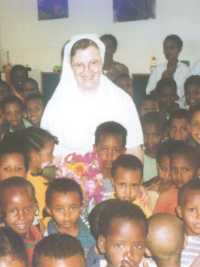 It was during my noviciate years in 'Friar Park,' Henley-on-Thames that I first felt I should like to be a missionary. I made my request in writing hoping to be sent on the missions after my profession. My first 'mission' was in Ireland and there I remained working in our houses until 1964. Image my joy when I was asked to go to South Africa. When my August 1964 annual retreat ended, the Provincial, Sister Catherine Moore informed me, 'Sister Esther, your assignment has been changed. Right now you will go to Gozo Island, Malta for one year. After that you will go to Africa.'
My one year in Malta became 17 years. Looking back on those Gozo Island years I cherish fond memories of the children and families whom I influenced and whose lives, in turn, touched and influenced mine.
When I returned from Malta in 1981 I spent the next 16 years working in Oxford, Liverpool and Scotland. In April, 1997, I once again put forward my missionary request and my superiors gave me the 'go ahead.' I was to go to Africa for a three-year period. I felt great joy. My dream was to become reality!
I left Oxford in September of 1997 for Nairobi, Kenya, where I remained for two months at the Noviciate house awaiting the visa for my destination, Adwa, Ethiopia. On November 14th I found myself on my way to Addis Ababa, the capital of Ethiopia. During my week in Addis I went from office to office in order to get the necessary paperwork done. At the police station I was fingerprinted and my teeth were looked at and counted for identification purposes!
Finally I was on my way north to Adwa. It was November 22nd when I boarded a small plane for the journey of a little over an hour from Addis to Axum, just outside Adwa. Legend and history crown this little town as the home of the 'Queen of Sheba,' and mother to King Menelik, founder of the Solomonic dynasty. This links Ethiopia with the Kingdoms of David and Solomon. The Ethiopians proudly believe that the Holy Ark of the Covenant itself is housed in Axum. On my arrival at Axum Airport I heard the sound of a whistle, which was a signal for the cows and donkeys to clear the runway so that the plane could take off. I was in another world. After finding my luggage among the pile left on the nearby field, we were on our way to Adwa, a quaint wee town surrounded by crusty mountains towering into God's blue sky.
Adwa has a population of about 128,000. It has 23 small towns, 84 villages I hospital, 3 health centres, 5 clinics, I teacher-training institute, 1 technical school, 25 elementary schools, 3 kindergartens and 72 Churches, mostly Orthodox.
Our Adwa Don Bosco Mission is a joint effort of the Salesians, Fathers, Brothers and Sisters. We have a Technical School and a large Oratory. The Salesian Sisters focus primarily on education but also on social assistance in close collaboration with the municipal authorities. We are six Sisters at the Mission, a very international community. There are two from Italy, one from England, one from Ireland, one from India and one from the United States of America. We run a Kindergarten programme with over 200 children ranging in ages from three to five years. Our primary school will expand this September to about 150 pupils. Our school children daily receive milk and bread as part of our school nutrition programme. We also have a two-year cutting and tailoring course that held its very first graduation in February of this year. Our computer course for adults is establishing a fine reputation with 40 students completing the course in February. The second course is now underway.
We give social assistance to as many needy people of our area as we possibly can. We have over 600 children in the adoption-at-a-distance programme thus providing these children with money for food, clothing, housing, health care and education. We also have about 30 orphans that are legally wards of the Sisters. These children are carefully placed in good homes and their growth and development is closely monitored. About 80 adults, mostly women, are employed at the Mission either full-time or part-time. We offer free ambulance service to the hospital for expectant mothers.
During these past three years I have received far more than I've given. It has been a humbling and enriching experience with happy and sad memories.
The women here work very hard and show a great endurance for pain in all circumstances. They live from day to day showing a unique trust in God's Providence. They have none of life's comforts or commodities, as we know them. Their houses consist of one room which shelters everyone, animals included. Most women have to draw water in a jerry-can from the nearby river, whose riverbed is dry most of the time. Children here hardly have a childhood. At the age of eight most girls find themselves totally responsible for their younger brothers or sisters.
The conflict over the last two years between Ethiopia and Eritrea has taken its toll of suffering in our people. Fathers of families have been taken to fight by the thousands, many never return. Boys are snatched from their homes and schools and forced into military service. Women and young girls are sent to the front lines to wash, cook and care for the soldiers. Many girls return home pregnant and HIV positive with their lives and the lives of their children destroyed. In Adwa alone it is said that two out of every three people have AIDS. These people know that we are here for them and will help them in their many needs. We, in turn, feel that they love us.
It has been a privilege to follow my dream. I would encourage anyone to give a few years of their life in the Missions. There are the inevitable ups and downs but these should not put anyone off. I encourage whoever feels the call to trust in God and to believe in their God-given ability to serve. I did and I am most greatly blessed. My dream has become a reality and so can yours.
Climb Every Mountain by John Paul Farrugia
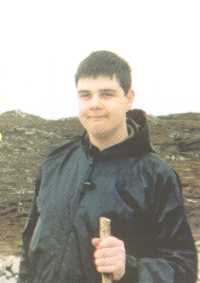 Little did we know what would await the six of us especially when you consider the fact that you are going to spend an entire week with Fr Tony and Mr Dadswell - the shock, the horror. Anyway these are the adventures and sufferings that we shared during that week in Ireland.
Day 1
We gathered in the chaplaincy at 10.30 pm, all eager to set off. For one hour 30 minutes we played pool and chess. At Midnight we set off in the minibus for a long journey. We travelled for a whole 8 hours before we reached the boat.Day 2
Finally on the boat. Tired and exhausted and in need of some sleep. Father Tony and Mr Dadswell decided that they would play some music. As you would expect their taste in music was awful. I know they would disagree with us. However, we know the truth.Reaching Ireland we had a few more hours in the minibus. Our first job was to collect some Bibles, 700 of them! One for each pupil in our school. We had to fit these into the minibus. However, we were still comfortable as they did not take up that much room.
A restaurant called Harry's, and the first time that we would eat since we left England. Overall the food was nice. We then went outside and looked at the shops. We went back in the minibus till we reached the house that we were staying, in a place called Westport. We put our things in our rooms and some of us unpacked. We watched TV and played pool on the mini-table that Fr Tony had brought with him. After several hours we went out into the town, looked around and ate at 'Supermacs', a cheap imitation of McDonald's in my opinion. We went to look around the town a little more and then went back to the house to sleep.
Day 3
We woke up the next day fairly early, at around 9 o clock. I had a cold shower, as the shower that day was not working properly and got dressed. Mr Dadswell played chef and cooked breakfast. Everyone said that he was a 'stunning superb cook'. I think he has found a new profession.After breakfast we set out in the minibus once again but this time we only travelled for about 20 minutes. We saw a mountain called Croagh Patrick. Fr Tony said that we were going to climb it. There were fears however of Foot and Mouth Disease. We were uncertain if we were going to be allowed to climb the mountain. To my dismay we were given the go-ahead.
As we began to climb I was horrified when I heard the height of the mountain, and how long it would take to climb it. I was not only frightened of not making it to the top, but I hadn't told them I have a phobia when it comes to heights. In the course of climbing I nearly died of pain. I felt I was a hindrance to the others as they were not having as much difficulty. Mr Dadswell and Fr Tony were terrific in helping me, offering lots of encouragement. They were so patient. They pushed me to the peak. I had climbed a mountain!
This was quite an achievement for me and though at the time I said that I would never go up there ever again, perhaps in the future who knows I may want to relive that experience.
Back to the minibus. Time to go to home where we could relax, or so I thought. Arriving home I went up to my room, struggling up the stairs. Every single muscle and bone in my body was aching. I relaxed for a few minutes and changed my wet and muddy clothing. Father Tony then informed us that we were going to Ballintubber. The reason that we were going to Ballintubber was that we were going to see a re-enactment of the crucifixion and the resurrection of our Lord. We did. After that we went home, watched television for a while and then went to sleep to see what awaited us next.
Day 4
I woke up the next morning and got washed and dressed. Once again Mr Dadswell was cooking. Fr Tony was putting his feet up. No. He was planning what we would do next. We set off and went to Knock where there is the Shrine of Our Lady. There we collected holy water and Fr Tony said Mass. We then looked around, saw statues of Mary and a Celtic cross. We had lunch somewhere near the shrine. In the evening we went to Castlebar where we went bowling, Quaser and go-karting. It was a lot of fun and we enjoyed it so much. We then went home, watched TV and went to sleep.Day 5
We woke up as per usual and got washed and dressed. Mr Dadswell was cooking for us. We were told that we were going to go to Ballintubber where we would have a cultural and historical tour.We set off for Ballintubber and I expected some sort of museum but it was not. In fact it was interesting. It was a new and different experience. The person who spoke to us about the Celts, the Druids, and St Patrick was Fr Frank Fahey. He made his speech interesting and we learnt a lot from the time that we spent with him. After our talk with Fr Frank we went to Ballintubber Abbey. There we learnt more about the history of the abbey and the people that built it. Some of the others went up to the roof of the abbey. I didn't. You have to climb a rope.
We then left the abbey and went back home. Fr Tony and Mr Dadswell prepared a Passover meal for us. We were expecting some visitors, Fr Tony's cousins were going to join us that evening. Our Passover meal, a great evening, then goodbye to our guests. It was 1 am before we got to sleep.
Day 6
We all got washed and dressed, all had breakfast and made certain that all our baggage was put into the minibus. We went into the minibus and went round some mountains and went to some beaches as we wanted to see as much of Ireland as possible. The views and the beaches were spectacular. Some of us fell asleep in the minibus during that time, myself included, as we had got up so early that morning.At 3 pm on Good Friday we stopped by a mountain for the Stations of the Cross. We continued our journey to the Salesian University Hostel where we would spend the night.
We arrived at the university at 10 pm and were greeted by some very friendly people. We had refreshments and watched some television downstairs and then finally at around 12 pm we all went up to our rooms to sleep.
Day 7
We got up, washed and had our breakfast. Back into the minibus to make our way home. Then there was the boat crossing, which was fine. Back in England we travelled for hours (about 5 or 6) to arrive back at school. At school however, Fr Tony had a little surprise up his sleeve. He told us that before we were allowed to leave some of us had to clean the minibus and some of the others had to carry the snooker table and accessories that we took with us. things offOur holiday had finally ended and we returned home where we all enjoyed an extra one-week holiday. The people that attended the trip with me were Fabio, Alexandar, Luis, Anthony, and Darren. Ireland is a fantastic place to visit. However, it is good to be back home.
ON THE ROAD by Catherine Cassidy
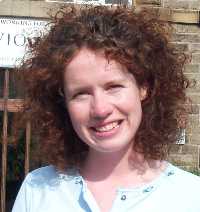 It was on the road from Durham to Stanley, around the village of Sacriston, that I first found out that I had been accepted as a volunteer. But it was well before this that my story really begins. Let me explain.
Having just finished my degree at London University, I was very unsure about what to do next, which direction to head in. Childhood dreams of journalism and working with animals had evaporated. I was back to square one. It was while discussing my indecision with one of my tutors that the idea of Salesian volunteering was first mentioned. The name immediately rang a bell and many memories came flooding back: good memories. Me in primary school, eagerly awaiting the arrival of the Salesian Priest or Brother to take us for a reconciliation service, or to accompany us on a school trip, or simply to come and chat with us. Such a visit would always guarantee certain things: a friendly smiling face, lots of fun, and the certainty that these guys really enjoyed being with us. With these memories in mind and a leaflet on volunteering in my hand, I filled in my application form and the wheels were set in motion. From this came an interview, a reunion with some of the priests from primary school; a little bit older now but still smiling! And then the letter through the post telling me my application had been successful.
So it was on that road from Durham to Stanley, that my dad told me the bad news. He had received a phone call to say that my initial voluntary placement hadn't worked out. But the good news was that I was very welcome to go to Savio House instead. I knew something of Savio Retreat House and the work they did there. After getting over my shock at the bad news, I really warmed to the idea of my voluntary year being spent at the big Salesian house in the country.
Friends asked me if I was nervous going to a place I hadn't seen before, to live with people I didn't know at all. I guess I was. I needn't have worried. It was a bright, sunny Sunday afternoon, around the beginning of September 1999 when I arrived, and saw Savio in all its loveliness.
I don't think I could ever have imagined what living and working at Savio would be like. It was so completely different to anything I had experienced before. The atmosphere, as soon as I entered, was one of warmth and hospitality. I was welcomed with sincerity and genuine friendship. A welcome I have received from so many Salesians. No undertones of 'Oh, you're a young person, I'll speak differently to you,' but accepting me with real interest and as an equal. This is a lesson I have learnt from my time with the Salesians, and taking part in their youth work. Young people hold so much value and worth within them, they are to be treated with the same respect and values as any other person. The young people I have sat with, talked to, worked with in my time here have increased within me the desire to spend more time with them, because from them there is so much to be learned and so much to be gained.
I have gained and experienced a lot during my time as a volunteer and worker at Savio House, and a great deal of this has been from living as part of a team and a community. At university I lived with people that I had never met before, in a shared house and part of me thought community living would be very similar to this. But this assumption on my part was wrong. Community life is something far more enriching, challenging, eye-opening, frustrating and all together different from any of my other experiences.
One of the most fascinating aspects of living in community is seeing the changes that take place during the year. As everyone relaxed into their new home and new role, I began to appreciate their personalities. Their good qualities and their limitations. At Savio I have become aware that we, as individuals, are cherished, our different characteristics, talents and gifts are encouraged. We are made to realise who we are, both through the work we do, and our interaction with one another. I have learnt things about myself that I never knew before. Some have made me proud. Others I sometimes wish I had never discovered.
In such an atmosphere of discovery, not only about oneself but also about others, many qualities are needed. Acceptance of the differences between one another, tolerance of characteristics that we may find are at odds with our own. Reassurance, affirmation and honesty to enable one another to grow in their own personalities. The last attribute, honesty, is one which I know has to be treated and handled with care. I find that I need to balance my wanting to be myself and to express my own opinion, yet needing to take into account others' reactions, and how they will take my words. My Dad always said to me, although I have failed sometimes, I have always remembered this, and found it invaluable advice, especially in community life.
The only other real community I have lived in has been that of my family. In many ways, community life at Savio is very similar. There is a real sense of looking out for one another, and I find it a really comforting experience. These people, who just a few weeks ago were complete strangers to you, are now your friends. There are people within the community you know you can turn to for different needs, just as in a family you turn to Mam for some things, speak to Dad for another. There have been many occasions, during my time at Savio, where I have needed a shoulder to cry on, this has never been lacking. It is these times which will particularly stay in my mind. Just as we don't speak to all our friends or family about certain issues, I have found that in community, there are those that I can turn to more readily and comfortably. This is not a criticism of the others, but because I may identify more with one person than another. It has taken me quite a while to feel comfortable with this realisation, as I used to think that community involved sharing to the same depth with every person there. Now I know this isn't possible, and I also know that sharing can take many forms. My sharing with each individual in our community will be just that - individual, but unique.
When young people come on a retreat at Savio House, the experience offers them a chance to get away from their everyday life. Away from the pressures of home and school. To experience something different. To think about their own lives. Through all these they are given the chance to shine and to blossom. For me, my experience of being at Savio has been very much like this. I feel as though I have been given a wonderful chance to step out of my 'normal life'. Not just in a geographical or career sense, but that I have been able to look at the person I am, the values I hold, and the dreams I have. Don Bosco has always been described as a man of vision, who followed his dreams. At Savio I have been able to discern more clearly what my real dreams are, what it is I really want from life. Never before have I been made so aware of the way I interact with and relate to others, but because of literally spending 24 hours a day with one another here, I see much more clearly the type of person that I am. I have been privileged to live with and meet so many people that I admire. Whose very presence and personalities have helped me in my own journey of self-discovery. I have been privileged to be a part of the Savio Retreat Team, and meet so many shining and blossoming young people who fill me with hope for the future. I have been privileged to spend this time here at Savio House.
So, it was on that road from Durham to Stanley, around the village of Sacriston, that I first found out I was going to Savio House. That road is filled with quite a few twists and turns, it slopes uphill and downhill. The road I have travelled at Savio has been very similar, and it was and is the best road I could have taken.
Fr Eddie Murphy SDB 1941 - 2001
 I first met Eddie when we arrived at the novitiate together in 1959 and discovered that he was a fellow-Wiganer. Prior to that Eddie had been a boy at Thornleigh and had done one year working with British Aerospace. We were together for the next four years during our novitiate and philosophy. Eddie then went to Farnborough and Shrigley doing some teaching before going to our university in Rome for his theology and ordination at Thornleigh in 1971. After ordination Eddie did a year each in Farnborough, Beckford and Shrigley before going to Bootle for the next six years. This was followed by six years in Bollington which included a renewal course in Rome. After a brief spell in Bolton, Eddie moved to Stockport while preparing for his move to Australia.
Eddie was to spend eight of the next eleven years at Engadine, Australia, working in the parish of St John Bosco. In between times, he had brief stays at Oakleigh, Bairnsdale and Brooklyn Park. I'm sure that everyone there will have their own memories of Eddie. It was above all in carrying out his priestly ministry to those suffering personal tragedies and bereavements that he seemed to come into his own.
Eddie was well-known for his sense of humour and vast selection of jokes. Like many a good story-teller he could not always recall how many times he had told a joke to a particular audience but a blunt reminder in mid-stream that he had told us that one before never seemed to deter him or prevent him from finishing the tale!
Eddie's sudden death at the age of only 59 leaves all of us with a deep sense of shock and loss. We thank the Lord for Eddie's friendship and for the way he was able to touch in such a rich and varied way many people lives.
Fr Charles Garrick SDB
Fr Pearse O'Byrne 1917-2001
 For almost 68 years of his life Pearse was a Salesian of Don Bosco. Together with his younger brother Brendan, who also became a Salesian priest, he completed his school studies at the Salesian College Battersea. He entered the Salesian Noviciate in Cowley, Oxford in 1933. Ten years later Pearse was ordained Priest at Blaisdon.
 After his Ordination he went to Chertsey where he taught for eight years. In 1951 he moved to Battersea for further studies at London University. Having obtained his BSc in Chemistry he joined the staff at Salesian College Farnborough. He taught there for more than 30 years till his retirement. For many years he helped in the parish at Crowthorne. He remained in the Farnborough Community till a year before he died, when failing health necessitated a move to Nazareth House Hammersmith for medical and nursing care.
All of us who were privileged to know Pearse benefited from his wonderful sense of fun. He was blessed with a great sense of humour and the twinkle in his eye guaranteed an appropriate humorous comment on every situation. He was a gifted teacher whose hard work and scholarship won the lasting respect of many hundreds of students. He was able to share with them his love for science and his love for life. Pearse was someone who could put both the young and the old at their ease, and win their love and affection instantly.
When I met him in Nazareth House less than a fortnight before he died he looked very smart and was sitting in his wheelchair ready to move to the dining room for lunch. He still had a twinkle in his eye and I remember him laughing when I reminded him to behave himself. By any standard Pearse was one of life's characters. He will be remembered with great affection by all, pupils and fellow Salesians alike.
Fr Francis Preston SDB
Bro Michael Grix 1938 - 2001
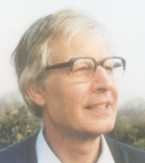 Michael was born in Dowlais, Glamorgan in 1938. His faith was rooted and nurtured in a strong Christian family. He came under the influence of the Salesians when he went to Farnborough in 1946 and then on to Shrigley. He entered the novitiate in Burwash, Sussex, in 1956 and took his first vows as a Salesian on September 8th 1957. For many years after that Michael worked as a cook in such places as Melchet Court in Hampshire, Bollington, and Burwash. After two years in Ireland at Ballinakill he came to Shrigley in 1968 staying until its closure in the 1980s. I think, that of all the houses that Michael lived in, Shrigley held a special place in his heart. After Shrigley Michael moved up to Bosco House in Glasgow to begin a new mission in Don Bosco Publications. His final move was here to Bolton in 1987.
The work of publications was very close to the heart of Don Bosco and Michael worked with great energy in this apostolate. Alongside his work on the Salesian Bulletin he had a wide correspondence with so many people who benefited greatly from the time and care he took to write letters and notes of encouragement.
In October 1999, when Michael was diagnosed as having malignant melanoma, his life moved into its final and quite remarkable phase. Michael was by nature humble. He was never one to force his opinions on others. It was easy to underestimate him. But during these last months of illness Michael's true qualities began to shine through. While his community and friends were in a very real sense ministering to Michael in his sickness, he in a far deeper sense in his vulnerability and brokeness was ministering to us. Michael had a very special devotion to Our Blessed Lady. Finally she came to take him home to her Son in great peace and beauty.
Michael Cunningham SDB
Brother Bartholomew Wreh, 1973 - 2001
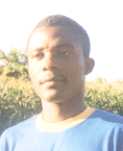 Bart was killed in a tragic motor accident in Monrovia. He grew up in Kru County, a remote part of eastern Liberia that borders the Ivory Coast. He came from a large family, he had 14 brothers and 14 sisters. His father, a paramount chief, had several wives and has never embraced Christianity. Bart received some of his early education in the faith from one of the small group of dedicated missionary Sisters who worked in Kru County. His secondary education was disrupted by the years of civil unrest. It was during this troubled period that Bart met one of the American Salesians who were working in the border area, Fr John Thompson. Fr John's commitment to the welfare of the Liberian people greatly impressed Bart. He became one of Fr John's helpers and gradually the conviction grew within him that the Lord was calling him to become a Salesian.
 After completing his pre-novitiate in Monrovia and helping out with work there, Bart and his companion, Brother Joseph Wiah, travelled to Nigeria for their year of novitiate. Having completed their novitiate and taken their first vows, Brothers Joe and Bart travelled to Tanzania to begin two years of study of philosophy in Moshi.
It was last July that Bart and Joe returned from Tanzania to Monrovia to begin their practical training. From then till the time of his death Bart lived at the parish house in Matadi. He spent his day helping out in the youth centre, taking classes at St John Bosco Technical High School, and helping look after the four new aspirants.
The Lord came for him unexpectedly. I don't doubt that Bart was ready to meet him and that he is now enjoying that fullness of life for which we all long.
Fr Francis Preston SDB
Rosie goes to church
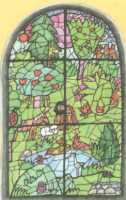 The naturally inquisitive mind of a child wants to know the answers to so many questions. Churches are special places which can fascinate children. But how to answer them when they ask such questions as, "What is a tabernacle?" or "What does 'Anno Domini' mean?" This small book attempts to answer such questions in a simple but attractive way. It follows Rosie and her family on their journey of discovery in church, an enjoyable but instructive experience for them and for any child who reads this book. The book would a splendid present for parents, grandparents, godparents or friends to give children for their First Communion.
Rosie goes European
The idea for this book started in Munich at a meeting of Salesian Publishers. They were looking for a project to mark their intention to unite forces for the European production of suitable religious books for children and those who work with the young. They decided to begin with a book on the church for primary school children. A basic German version was finalised. With the writer from Munich and the artist from Prague, the European character of the pilot project was well and truly in evidence. By October 2000, an advance copy of the book was ready for discussion. Language was still a problem between members of the group and discussions had to be carried out in Italian English and German!It was intended that the book would appear in eight languages and there would be a run of about 20,000 copies. The book would have the same drawings in full colour in all eight versions. Only the text would differ. Such a combined production would make it easy to print and cut costs enormously.
And so 'Rosie goes to church' was born, a truly European child speaking English and bringing with her the rich cultural heritage of Christian Europe.
We are confident that this book will mark the beginning of a fruitful partnership with our fellow European Salesians. Watch this space.
Rosie goes to church Hardback Price £3.99 (+ P&P 80p UK only) ISBN 0-9538991-3-6 available from Don Bosco Publications Thornleigh House Sharples Park BOLTON BL1 6PQ